


Every practitioner in this field has heard the reassurance. I’ve combined them before and I was fine. My clients have done it. Nothing happened.
Dr. Rabin has a response to that reassurance, and it isn’t a statistic.
It’s a question he has asked in teaching rooms for years, in front of thousands of practitioners: has this ever happened to anyone here, or to anyone you’ve worked with?
And in almost every room, one hand goes up.
Not after the deep, full-strength work, either. In this clip he tells you exactly what those raised hands have in common, and the detail is the part that should stop you: the doses involved were the smallest ones used in this field. The ones widely assumed to be too gentle to carry any risk at all.
One hand per room doesn’t sound like much until you do the arithmetic on a career.
Across the hundreds of clients a practitioner sees, “rare” arrives eventually — and when it arrives, it’s a medical emergency, not an inconvenience.
Then Dr. Rabin describes the pattern that makes the risk worse, and it’s one many well-meaning practitioners are following right now. When medication blunts the experience, the instinct is to reach for more until something shifts.
He walks through why that instinct points in exactly the wrong direction, and what the responsible sequence looks like instead.
The reassurance from people who were fine is real. It’s also exactly what a survivorship bias sounds like from the inside. Press play for the minute that answers it.
SSRI Deprescribing & Psychedelic Readiness Certification
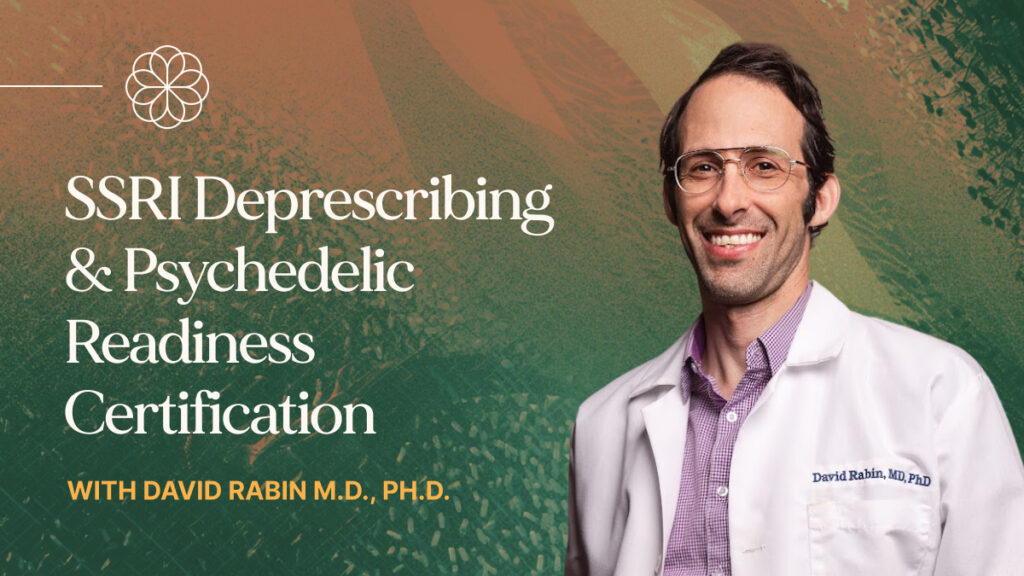
Learn the full protocol directly from Dr. Dave Rabin. Six live 90-minute sessions, six facilitated labs where you work real cases, and pre-publication access to his clinical deprescribing manual. Three months, starting October 7. 7.5 CE credits available for eligible clinicians.
SEE THE FULL CURRICULUM →
Next in this series: Most people who start one of these medications are never given a plan for coming off. Dr. Rabin explains why that happened, and what indigenous ceremony traditions and Western clinical protocols already agree on.