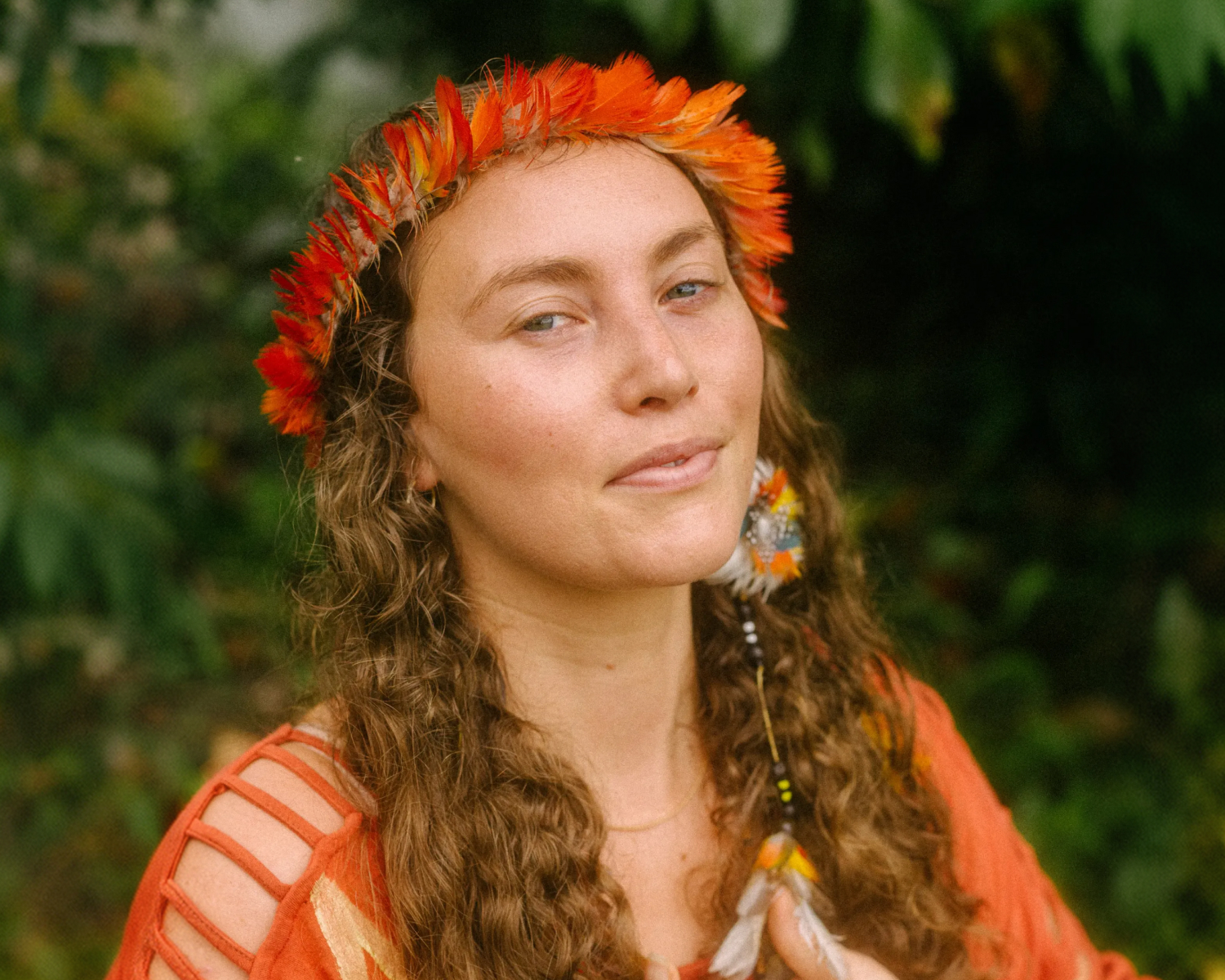


Mariah Gannessa is the Founder and CEO of Four Visions, an organization that helps facilitate access to ancient botanical traditions for thousands of people each year. She describes herself as a bridge-builder: a Westerner whose life has been shaped by Indigenous traditions and lineages that welcomed her into relationship with their teachings. Her work is grounded in reciprocity, humility, and service.
Mariah is faculty for the Psychedelic Practitioner Certification, whose next cohort begins on January 20, 2027. She describes her work as a living exchange with the traditions she learned from, not a borrowing of them. In the reflections below, Mariah shares what a mature standard of care requires, why a practitioner’s own healing is the foundation of their work, and why integration is where transformation happens.
Questions with Mariah:
From your perspective, what feels most important for the psychedelic field to get right in the next 5–10 years?
We are living through a remarkable moment in which ancient traditions are meeting the modern world on an unprecedented scale. What feels most important is that this exchange happens with integrity, humility, and deep respect for the cultures that have safeguarded these medicines for generations.
As these medicines become more widely available, we have an opportunity and a responsibility to establish a mature standard of care. That means prioritizing proper training, ethical facilitation, informed consent, cultural context, and ongoing integration, rather than simply increasing access. The future of this field will be shaped not only by the medicines themselves, but by the quality and training of the people entrusted to steward them.
How do psychedelics intersect with your work, and what feels most misunderstood from where you sit?
I often describe myself as a bridge-builder, a Westerner whose life has been profoundly shaped by Indigenous traditions and lineages that graciously welcomed me into relationship with their teachings.
One of the deepest inquiries of my life has been learning how to honor both where I come from and the traditions that have transformed me. My work is not about borrowing from another culture; it is about participating in a living exchange grounded in reciprocity, humility, and service. I strive to honor the wisdom of Indigenous peoples, the plants themselves, the spirits of nature, and the greater web of Creation while remaining authentic to my own path and ancestry.
One misconception I sometimes encounter is the assumption that this work is inherently one of appropriation. My experience has been something quite different. Relationships built over many years, guided by elders and rooted in mutual trust and respect, carry a responsibility that extends far beyond adopting practices. They require living the values, protecting the traditions, and helping ensure they are transmitted with integrity.
Ultimately, the only validation I seek is whether my work is in genuine service to humanity, to Nature, and to the communities that have entrusted me with these teachings.
What do you think practitioners today most need to cultivate in themselves, not just learn intellectually, in order to work responsibly with these tools?
The greatest qualification for guiding others is not how many books you’ve read or certifications you’ve earned; it’s the depth of your own relationship with the medicines and your willingness to continually do your own work.
These medicines ask us to cultivate humility, self-awareness, discernment, and emotional maturity. They invite us into a lifelong process of healing and self-inquiry. The more deeply we embody the lessons they offer, the more authentically we can hold space for others.
A practitioner’s personal healing journey is not separate from their professional development, rather, it is the foundation of it. Our capacity to serve others is directly related to the depth of our own integration.
Is there a principle, practice, or insight that has become central to how you approach healing and transformation? How did that understanding develop for you?
One of the greatest lessons these medicines have taught me is that the ceremony itself is only 50% of the work.
The experience may open the door, but transformation happens through integration. The real practice begins when we take the insights we’ve been given and embody them in our relationships, our habits, our choices, and the way we move through everyday life.
Without integration, powerful experiences often remain beautiful memories. With integration, they become catalysts for lasting transformation.
I often say that the medicine may last a few hours, but life itself is the ceremony. These tools are ultimately meant to help us become more present, more loving, more responsible, and more fully alive in our everyday existence.
What’s a question you find yourself returning to again and again in your work right now? Why is it important to you?
How do we allow these traditions to evolve while preserving the wisdom, context, and integrity from which they emerged?
Humanity is experiencing what feels like a collective remembering of the sacred. As these medicines become woven into Western society, new models of practice, facilitation, and healing are naturally emerging.
Evolution is inevitable, and often necessary. But so is stewardship.
As someone who helps facilitate access to ancient botanical traditions for thousands of people each year, I feel a deep responsibility to continually explore where innovation serves these medicines and where preservation is essential. I don’t believe this question has a fixed answer. It requires ongoing listening, curiosity, discernment, and humility.
When you think about microdosing specifically, what do you see as its most responsible or promising role within the broader psychedelic ecosystem? Where does discernment matter most?
I love the concept of microdosing, and it’s important to remember that it isn’t a modern invention. Many Indigenous cultures have long understood that smaller amounts of medicine can serve those who, for various reasons, were not able to participate in full ceremonial experiences.
Microdosing offers people access to the subtle intelligence of these medicines in a way that can be integrated into everyday life. I also see it as a beautiful companion to deeper ceremonial work, helping people continue integrating insights long after the ceremony has ended.
Where discernment becomes essential is when any medicine (whether a microdose or a full ceremonial dose) becomes something we rely on as a crutch rather than something we learn from.
It’s important to create periods of space without the medicine, allowing ourselves to honestly reflect: What has changed? What still needs tending? How am I embodying what I’ve learned? That rhythm of engagement and recalibration is what keeps the relationship healthy and sustainable.
What excites you about contributing to this training at this moment in time?
It is truly an honor to be part of the Psychedelic Practitioner Certification faculty.
What excites me most is that PCI is helping establish a thoughtful standard for what responsible practice can look like. As this field continues to expand, I believe education, ethics, and mentorship are more important than ever.
I’ve especially enjoyed connecting with students from such diverse backgrounds, each bringing their own gifts, experiences, and sincere desire to serve others. To contribute even a small part to their development and to the positive impact they will go on to have in the world is something I feel deeply grateful for.
What drew you to contribute to the Psychedelic Coaching Institute’s training programs?
Throughout my journey, I’ve been incredibly fortunate to learn from extraordinary Indigenous elders, teachers, and mentors who generously shared their wisdom with me. Their guidance has profoundly shaped both my life and my work.
When I was invited to join the faculty, I saw it as an opportunity to honor my teachers by paying their generosity forward.
I believe knowledge carries a responsibility. If our experiences can help others walk this path with greater integrity, humility, and discernment, then sharing them becomes an act of service. It is a privilege to contribute to the education of practitioners who will, in turn, go on to serve countless others.
Mariah’s perspective reflects the Psychedelic Coaching Institute’s focus on cultural humility, practitioner maturity, and integration as the heart of the work. Her work reminds us that how we hold these traditions matters as much as how we use the medicines.
Learn more about Mariah’s work at Four Visions or connect with her on LinkedIn and Instagram at @mariahgannessa and @fourvisionstribe.
Learn from Mariah in the Psychedelic Practitioner Certification, starting January 20, 2027.
Learn to support psychedelic preparation and integration while respecting the boundaries between coaching and therapy. Our Practitioner Certification Program helps you build the skills to work ethically and recognize when a client needs clinical support.


